Redruth & Portreath community juicing
Growing – Pruning – Grafting – Workshops – Advice
We are delighted to share news of a grant awarded to us from The National Lottery Community Fund!
A HUGE thank you to The National Lottery for recognising the work we do to support communities to create, maintain & celebrate community orchards.
This grant will allow us to empower local residents to guide the care & development of local community orchards, providing resources, equipment & training to support orchard groups and responding to feedback from volunteers, park users, local residents and the local Council.
New apple pressing equipment will help us on our mission to ensure that apples grown in Cornwall are put to good use rather than wasted, as part of our commitment to promoting food security, sustainability and community action. Additional edible & wildlife attracting shrubs will bring diversity, protecting soils, boosting tree health & expanding harvests for all.
Approximately 75% of traditional orchards have been lost across the South West since the 1900s, along with wildlife that depend upon it. Our project will help the environment by restoring orchard habitat along with the skills to manage it, by people that live closest. In addition to being connected with nature, local people will be helping to develop a local food supply and a sustainable, resilient community, boosting positivity about the future. People will gain opportunities to get involved in positive action to tackle climate change, giving them agency to improve local green spaces.
This grant will:
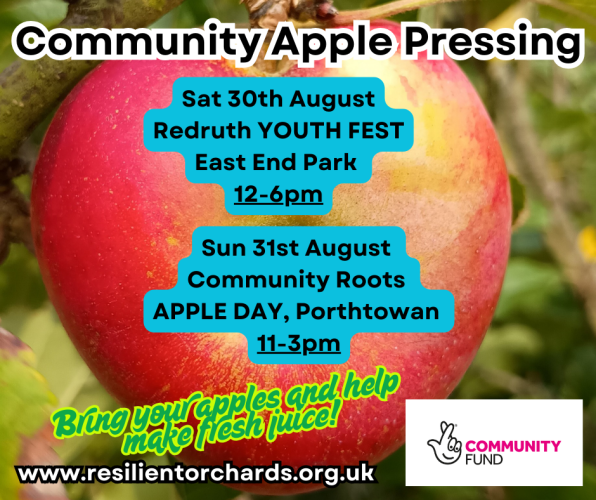
 support us to deliver community apple pressing sessions PLUS provide some new apple pressing equipment
allow community orchard groups to add edible, wildlife attracting & mineral accumulating shrubs alongside recently planted fruit trees
provide First Aid training for regular volunteers & freelancers
support us to train more people in orchard skills & empower local residents in Redruth & Truro to collaborate with one another to create and make full use of diverse orchards for all.
// Want to to get involved? //
Join an orchard organising whatsapp group in Redruth or via the Redruth email list, or get in touch by email or phone.
// Want to get updates? //
Please watch this space or join our email list: by sending a request to resilientorchardscornwall@gmail.com
The National Lottery Community Fund


Thank you to Andrew Tomsett for this write up of our apple juicing activity at Tehidy County Park Orchard, nr Camborne in 2022.

Apple pressing at Tehidy

On a recent bright Autumn day, the Tehidy park volunteer rangers
gathered at the orchard to press this year’s crop of apples.

The Tehidy orchard is owned by Cornwall Council and along with the
wood itself is managed by Cormac who provided the necessary equipment such as wheelbarrows and tables. A shiny new apple crusher and press purchased by Resilient Orchards Cornwall CIC with a grant from Cornwall Council's Community Chest Fund was set up.

The orchard contains several trees which are probably nearing 100 years old with the remainder of the 50 trees having been planted over the past 14 years. All are Cornish or West Country varieties. When the
derelict orchard was first ‘discovered’ by two senior citizens of Illogan the huge task was to clear an entanglement of brambles and wild clematis which had smothered the trees. This was achieved by community effort involving schools, scouts and diverse local people.

This season (2022?) most trees are bearing fruit with some of the oldest ones heavily loaded - the best crop ever!

The first pressing was of ‘Sweet Larks’ which, true to name, has as a pleasant, sweet flavour even in September. This would appeal to anyone with a sweet tooth and being a smallish tree would be suitable for most gardens. Interestingly this variety, known as a ‘burr’ apple or ‘pitcher’, roots from cuttings, something no modern apple will do.

Our cuttings came from a tree growing in Angarrack. In Victorian times this apple was marketed nationally as a sweet dish to follow a cream tea. An opportunity perhaps for a new Cornish enterprise?

Next came the curious fruit of the ‘Pear apple’ of which we have a large quantity this year. Despite its name it is not a pear or a  hybrid, just a pear-shaped apple. It is very early, sweet and can bear very heavily most years. ‘Pear Apple’ is suitable for early pressing but for those preferring a little more acidity, later ripening varieties can be blended in such as ‘Katy’ or even ‘Bramleys Seedling’ (in moderation) can be added whilst pressing. Bramleys Seedling is, of course, our leading British culinary variety. Our tree, one of our oldest, has, in its long life, fallen over twice yet it continues to grow and produce its superb cookers. The story of the Bramley apple is fascinating. It was raised from an apple pip in Nottingham about 1810 since when it has been propagated by grafting for the past 200 years, which means that every Bramley tree is genetically (for the most part, as there are a few Bramley variants in circulation) the same as the Nottingham tree, which is still alive today.

Apples are a wonderful crop. We grow them organically and the output
can be huge for minimal cost. The Cornish climate may not be ideal for
apple growing but interest is growing. A member of the orchard volunteer group for the past few years, Michelle Lawson, has formed an
orchard advisory group so you may visit this for help (Resilient Orchards Cornwall CIC - www.resilientorchards.org.uk) if you are considering planting. Of course organic orchards are wonderful for wildlife. Moreover, they capture carbon and can hold it for a hundred years.

Andrew Tompsett 2022


On 11th June 2025 a group of us, all orchard enthusiasts in various ways & members of the Cornwall Orchard Network, headed back to Haye Cider Farm with invertebrate expert Keith Alexander and Paul Gainey (multi species expert). Here at the orchard we repeated a survey that we carried out in September of the previous year. The aim being to survey at a time of year when the trees were in more active growth and see if a larger proportion of species could be found.

The full report can be downloaded below, but here a few excerpts from this report as compiled by Keith Alexander including significant finds from Paul Gainey also.
The highlights of the visit were four characteristic orchard species:

- Old galleries of Large Fruit Bark Beetle Scolytus mali had been noted during last year’s September visit but, following recent storms and the resulting freshly snapped branches of some of the apple trees, fresh galleries were seen this time as well as those of Small Fruit Bark Beetle S. rugulosus. As noted in my previous report, Hayes Farm Orchard is one of only two known sites in Cornwall for S. mali. No signs of S. rugulosus were found last year, but this is a better-known species in the county, with records from six other sites. This does suggest that the larger species is much more localised in the county as the smaller one will be relatively under-recorded.

- Last September only a single Apple Blossom Weevil Anthonomus pomorum was found but it was much more evident this visit, with one or two specimens found on quite a few of the apple trees. Its discovery in Haye Orchard in 2024 was the first report from Cornwall since 1935.

- Larval webs of Apple Ermine Moth Yponomeuta malinellus were spotted on several of the apple trees. The larvae feed gregariously. They are known to cause problems for apple trees up-country but there are notably few reports of the species in Cornwall, where adult moths have been found at light traps in six other localities. So far as we are aware this is the first time that the larvae have been found in the county. It seems unlikely that this moth would be a cause for concern here in Cornwall.

Did you know that in Cornwall, Illogan, nr Redruth, has it’s own collection of own root apple trees growing? Local residents Andrew Tompsett & Peter Malidine have been taking cuttings and growing ‘own root’ apple trees in local green spaces for some time.
These fruit tree cuttings have been taken from Cornish apple trees including ‘Sweet Larks’ and an unknown pitcher (another name for trees which can root from a cutting) at a local orchard. ‘Sweet Larks’ is a Cornish apple that produces small yellowish apples and has a history of being used for pickling.
As part of the Redruth Orchard Project we organised a session for taking cuttings for growing own root apple trees in November 2024 and participants went away to plant at their respective sites. Own root trees have been planted at community orchards in Redruth alongside grafted trees, wilding apple grafted trees and one seed grown apple tree. These orchards are not about creating uniform commercial orchards of one type of apple, these are places for food growing, they are places for relaxing and enjoyment, they are places for families, for picnics, for harvesting over as many months as possible and for wildlife. They are the perfect places for experimenting with different fruits, different ways of growing and new varieties. Importantly we are creating ‘resilient’ orchards that have a variety of different fruit trees so that if one type fails one year there might be something else that does ok. Moving a way from the monoculture to something more diverse.
More information about Sweet Larks variety and a recipe for pickling them here: Cornish pickled apple speciality ‘Pickled Sweet Lark’ by Andrew Ormerod (2011) | Cornwall and South West Fruit Focus
Phil Corbett, who championed the growing of own root apple trees and coppice orchard systems sadly passed away recently. His research and interest in own root trees carries on and you can find out more below.
More from Phil Corbett on growing trees on their own roots here:
Another link to more information about Phil Corbett’s work here
At Redruth we have a Sweet Larks apple own root tree growing well and also a Manaccan Primrose. We hope to plant more in future years rather than just relying on grafted trees.

As part of our Redruth Orchard Project we invited Tom Waters from Scythe Kernow to lead a peening instruction workshop for volunteers at Trenoweth Community Orchard last weekend. The volunteer team have been caring for the orchard space using scythes since June 2023 following an ‘Introduction to Scything Workshop’ some of the team attended which we organised to take place at St Ives Community Orchard. This dedicated workshop helped to hone skills and give confidence in getting the most of the blade, as well as introduce scything to some participants who have not yet done any practical scything.
Caring for and knowing how to get the most from our tools is important. Scythe blades, when well cared for, can be used for many many years and we hope that local people will still be mowing by scythe here in Redruth, using these same blades, for many years to come!


Not only is cutting the grass and brambles by scything far more pleasurable than using a noisy, smelly & polluting strimmer, but it is also a great workout AND helps ensure a greater level of biodiversity.
Here are some of the other reasons we scythe:
Least disturbing mowing method – Ensuring any wildlife has a greater chance to jump aside as the steady blade of the scythe edges closer.
Earth-friendly – Energy from people, rather than burning fossil fuels.
More control – Can get close up to tree trunks or other obstacles without causing damage; allows the scyther a higher degree of selectivity about what is cut and how, and therefore more awareness of what is growing.
Health & well-being – It’s a pleasurable activity, quiet and peaceful, and can be done at your own speed, taking breaks to sharpen the blade at regular intervals. Scything is a good physical work out!
Rake up and remove the grass, which is often trickier with strimmed grass, as it is shredded into small pieces. Removing the grass on meadows helps to ensure useful plant populations are not smothered out, and reduces soil fertility, supporting wildlife flower populations rather than just all grass.
Mulch – Can use the cut grass as a mulch elsewhere on food growing beds.
If you’d like to learn to scythe we hope to organise more ‘Introduction to Scything’ courses for Community Orchards in the future.
OR if you wish to organise a session, or are an individual contact Tom at Scythe Kernow in West Cornwall, or for East Cornwall you can contact Kevin at Skygrove Scythe School who is running scything courses now, check it out. Skygrove Scythe School even organises a Cornwall Scythe Meet – maybe we’ll see you there!


This funding has been allocated from Cornwall Council’s Community Levelling Up Programme. The Community Levelling Up Programme is part of the Good Growth Programme, which is delivering the UK Shared Prosperity Fund in Cornwall and Isles of Scilly.
Fancy listening to something full of hope & inspiration?!
Try this latest episode from Nature Connects podcast, produced by Tamar Valley National Landscape. Full of optimism for the future and lots of inspiration for orcharding and nature recovery in Cornwall & Devon.
Thanks to Mary Martin and James Evans for sharing their wisdom and fascinating observations from within their orchard and more, and for Nature Connects/Tamar Valley National Landscape for producing this.
Listen to this for some uplifting chat to encourage you to get back to your own orchard or to plant a new one next season!
#tamarvalleynationallanscape

Fruit Futures: Sustainable & climate-resilient fruit growing in Cornwall
Following on from our successful inaugural Cornwall Orchard Network meet up at Kehelland Trust in 2024, we invite you to join us at University of Exeter, Penryn Campus on Saturday 3rd May 2025. It’s FREE – thanks to funding from Forest for Cornwall who continue to support you to plant up new orchards across Cornwall – with refreshments & buffet lunch provided but spaces are limited so please book now!


Redruth Orchard Project has been given a boost with some welcome support from Cornwall Council’s Community Levelling Up Programme, which is part of the Good Growth Programme.
This funding allows us to take on some freelance community orchardists to run the project, bring more people into the orchard for enjoyment, social connection and positive action in response to worries about food insecurity or climate change. We aim to get more people practically involved, work with other organisations, schools and experts and to provide opportunities for local people to develop orcharding skills within the Redruth community. This will ensure local people can care for these orchards in the longer term and provide green skills that will be helpful to people in other areas of their lives, whether at the allotment, for those seeking employment in horticulture. Our community orchard sessions are also a place for social connection, for practical exercise and help to boost mental well-being.
The funds will allow us to install a metal storage shed & park bench at Trenoweth Community Orchard and plant more fruit trees at Trefusis Orchard. We also have the opportunity to work with with Redruth Town Council’s facilities team to plant up a new orchard at East End Park. We will purchase more tools and resources to support volunteers to care for the trees and orchard spaces, as well as more fruit trees, and supporting perennial plants and shrubs. Other opportunities are listed below, please get in touch.
Trenoweth Community Orchard
Trenoweth Community Orchard group volunteers have been meeting up regularly for over 2 years now to plan, prepare the site, plant trees, fundraise for tools, metal shed and other resources. With this new funding we have been able to ensure the installation and preparation of the base for the metal tools shed; run a series of sessions over Winter to help care for the space, hedgerows and trees; provide some opportunities for volunteers to visit older orchards in the area to gain practice in pruning older trees; water harvesting installation; add support plants and more fruit trees as some examples.


Trefusis Community Orchard
At Trefusis Community Orchard, we have been working with local people to create bug hotels to attract beneficial insects into the orchard to help improve the health of these trees. Volunteers have mulched the trees and so far two new apple trees have been planted, with Kew and Manaccan plums to be included here. New beds with perennial and woody plants will be added around the fruit trees to attract more beneficial insects.


East End Park Community Orchard, Redruth
At East End Park we will be working with Redruth Town Council, a local school and the local community to plant a new orchard. The trees to be planted include apples, plums and a medlar and we will be holding a community planting day in early February 2025.


Other activities have included visiting Tehidy orchard to collect branches to grow as own root trees.
Some upcoming opportunities to get involved in the Redruth Orchard Project:O
This funding has been allocated from Cornwall Council’s Community Levelling Up Programme. The Community Levelling Up Programme is part of the Good Growth Programme, which is delivering the UK Shared Prosperity Fund in Cornwall and Isles of Scilly.
Thank you also goes to Cornwall Neighbourhoods for Change (CN4C) for a grant from the Communities Working Together Innovation Fund that helped us to purchase the metal shed and some tools.

Also to South West Water’s Neighbourhood Fund to help us with a grant to install water harvesting as part of the Redruth Orchard Project.


Members of Cornwall Orchard Network took a trip to Haye Farm (Haye Farm Cider) which has contained an orchard for many many years. According to the proprietors, cider has been produced on the farm since the 13th century using apples from its orchards. There is a mixture of aged trees, most of the them mature, with some older, some middle aged but lacking younger trees to take over when the older ones start to die out.
We are really grateful to Keith Alexander (Invertebrates specialist), Paul Gainey (lots of specialisms) and Pauline Penna (Fungi specialist) for sharing their knowledge with us and identifying species. An exciting find was the Apple Tree Lace Bug Physatocheila smreczynskii, found mainly on lichen-covered apple trees (for more info and past sightings: Untitled (cisfbr.org.uk) ). It is featured in the Red Date Book for Cornwall & the Isles of Scilly (2009) and is a Species of Principal Importance for the conservation of biodiversity.
Also found was evidence of the Large Fruit Bark Beetle Scolytus mali on a dead apple tree.
We discussed the variety of habitats favoured by these species within each tree and how to ensure, when pruning and caring for older orchards, that we maintain these features. The different habitats favoured by different species – dry wood loving beetles, wet and rotting wood species – within just one tree.
Many thanks to Haye Farm Cider for allowing our visit. Do you have an old orchard that we could visit to have a search, learn and share? We’d love to hear from you. Or have you surveyed your orchard and found some interesting species?


